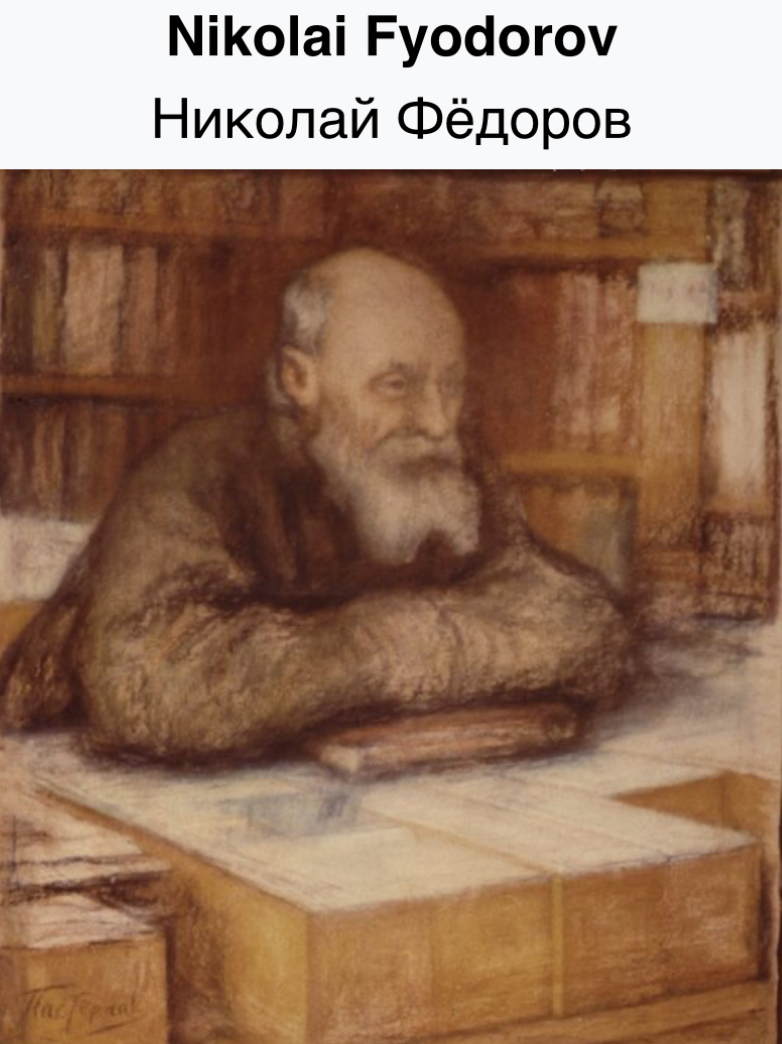
It’s the inspiration of Michael Frantz to name this library after Nikolai Fyodorov, a Russian philosopher and librarian at the Rumyantsev Museum who viewed libraries as active, sacred spaces for preserving human knowledge to achieve our “common task” of creating Heaven on Earth.
After his inspiration, we make our library into a meeting place of spiritual scientific & cultural exchange.
Funding for the library comes from Patrons like you – who support its care and its expansion with a tithe. Join the library benefactors here. The world needs sanctuaries of wisdom where spiritual science & esoteric teachings can thrive for generations to come.
Let’s make it so! Tithes & donations of books are welcome…
A little about Nikolai Fyodorov…
Libraries occupied a special place in Fyodorov’s philosophy. Fyodorov wrote about the great importance of libraries and museums as centers of spiritual heritage, centers of collecting, research and education, moral education. Libraries communicate with the great ancestors and should become the center of public life, analogous to temples, a place where people are introduced to culture and science.
Fyodorov promoted the ideas of international book exchange, the use of books from private collections in libraries, the organization of exhibition departments in libraries. At the same time he was against the copyright system, as it obviously contradicted the needs of libraries.
The concept of museum and library education developed by N. F. Fyodorov’s concept of museum and library education became the basis of the pedagogical programs of the International Society “Ecopolis and Culture”.
With the “Philosophy of Common Task” by N. F. Fyodorov begins a deeply peculiar philosophical and scientific direction of universal knowledge: Russian cosmism, active-evolutionary, noosphere thought, represented in the XX century by such major scientists and philosophers as mycologist N. A. Naumov [ru], V. I. Vernadsky, A. L. Chizhevsky, V. S. Solovyov, N. A. Berdyaev, S. N. Bulgakov, P. A. Florenskyand others.[47] Drawing attention to the fact of the direction of evolution toward the generation of reason, consciousness, cosmists put forward the idea of active evolution, that is, the need for a new conscious stage in the development of the world, when humanity directs it in the direction that reason and moral feeling dictate it, takes the wheel of evolution in its hands, so to speak. For evolutionary thinkers, man is still an intermediate being in the process of growth, far from perfect, but together consciously creative, called to transform not only the external world, but also his own nature. It is essentially about expanding the rights of conscious-spiritual forces, about the control of matter by spirit, about the spiritualization of the world and man. Cosmic expansion is one part of this grand program. The cosmists succeeded in combining care for the big whole – Earth, biosphere, cosmos with the deepest demands of the highest value – the concrete person. An important place here is occupied by questions related to overcoming disease and death and achieving immortality.
The planetary worldview put forward by N. F. Fyodorov and Russian philosophers-cosmists is now called the “worldview of the third millennium”. The idea of man as a consciously creative being, as an agent of evolution responsible for all life on the planet, the idea of the earth as a “common home” is important in our era, when more than ever before humanity is facing questions about the relationship to nature, its resources, to the very imperfect mortal nature of man, which gives rise to individual and social evil. Cosmist philosophers have proposed their own creative version of ecology, allowing to effectively solve the global problems of our time. The idea of fruitful dialogue between nations and cultures, each contributing to the “building of noosphere” is an effective means of education in the spirit of interethnic harmony, opposition to chauvinism, rivalry of “national egoisms”, put forward in this movement. The idea of continuity, memory, connection with the spiritual heritage of the past, which received a new ethical justification in the philosophy of N. F. Fyodorov, is relevant today. The reflections of cosmist thinkers on the need for moral orientation of all spheres of human knowledge and creativity, on the cosmicization of science, on the reconciliation and union of faith and knowledge in the Common Task of preservation and multiplication of life on Earth are important.
Fyodorov can rightfully be considered a forerunner and prophet of the noosphere worldview, whose foundations are laid in the works of V. I. Vernadsky and P. Teilhard de Chardin. The transhumanism movement that emerged at the end of the 20th century also considers Fyodorov its forerunner.[48] At the same time, transhumanism calls for endless human perfection with technical achievements, while Fyodorov considered technology a temporary, side branch of civilization development.[49] He believed that “the forces of man should be directed in the other direction – to the improvement and transformation of himself”.[50]
Reference : Wikipedia
 Wholeness River Retreat